Every evening, millions of people slip off their socks at the end of a long day without giving them a second glance. Yet for anyone managing diabetes or living with Peripheral Arterial Disease (PAD), that simple piece of everyday fabric can serve as one of the most reliable early-warning monitors in a personal foot care routine.
Podiatrists and wound care specialists frequently remind patients that skin breakdown in the lower extremities rarely announces itself with sharp pain. Because of sensory changes common in diabetic foot health, significant issues often develop quietly.
Adopting the daily white sock test for diabetic foot monitoring turns a routine bedtime habit into a proactive visual inspection—providing clear, high-contrast feedback on your skin integrity before minor friction turns into a larger concern.
The “White Sock Challenge”: Raising Awareness for Silent Risks
The concept behind using light footwear for health tracking gained national momentum through the Save A Leg, Save A Life (SALSAL) Foundation. Through initiatives like the White Sock Campaign, clinicians and patient advocates have used a simple white sock to spotlight the widespread impact of PAD, diabetic neuropathy, and preventable limb loss.
The campaign serves two vital roles:
- Public Awareness: Opening honest conversations about vascular health, nerve sensitivity, and proactive limb preservation.
- Clinical Utility: Demonstrating why light-colored textiles are essential diagnostic tools in everyday personal care.
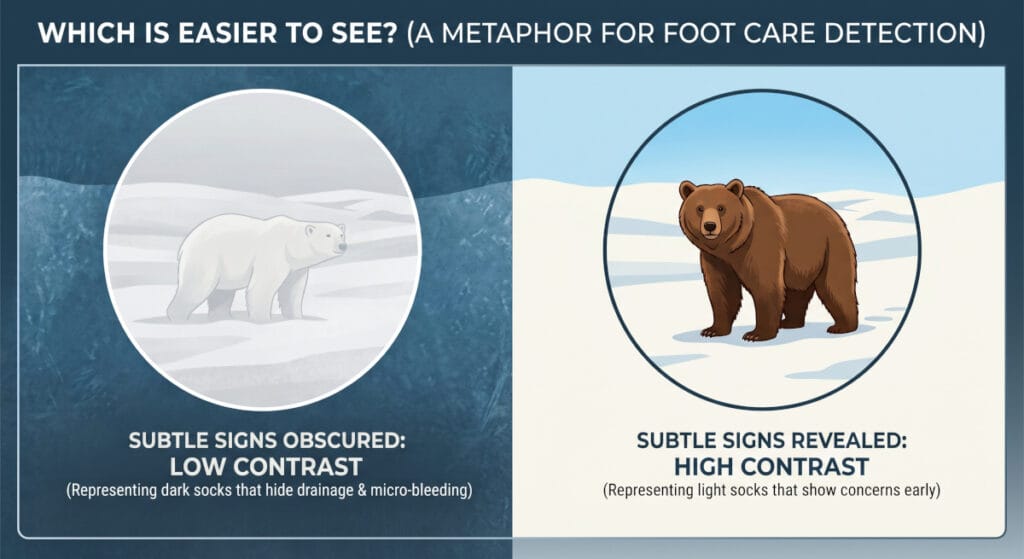
In everyday practice, light-colored fabric acts like a clean canvas. Dark fabrics obscure subtle warnings; unbleached, light-colored soles make them instantly noticeable.
The Neurology of Silent Damage: Why Wounds Go Unnoticed
When managing nerve health, pain cannot be relied upon as an early warning system. Understanding why requires a look at how diabetes alters nerve feedback and tissue repair:
1. Neuropathy Blunts the Warning Alarm
Elevated blood glucose levels over time can affect peripheral nerve fibers—a state known as diabetic peripheral neuropathy. Normally, pain alerts you when a shoe rubs a heel, a seam presses against a toe, or an object slips inside a shoe. When neuropathy blunts or removes those sharp sensations, that warning system goes dormant. A blister, micro-tear, or friction rub can occur throughout an active day without registering any conscious discomfort.
2. Slow Micro-Shearing and Serous Weeping
Before the skin surface visibly breaks, continuous mechanical friction (shear stress) stretches and weakens delicate epidermal layers. This micro-stress can cause the skin to weep serous fluid—a clear or light yellow plasma exudate—or release pinpoint traces of blood. Because no pain accompanies this process, the fluid absorbs directly into the sock fabric completely unnoticed by the wearer.
The Three Pillars of Foot Health
Supporting sensitive feet requires a balanced, daily approach built around three core mechanical factors:
Pillar 1: Circulation (Supporting Arterial and Venous Flow)
PAD narrows peripheral blood vessels, reducing arterial flow to the lower extremities and slowing the natural healing process. Standard socks with restrictive, tight elastic tops can act like mini-tourniquets around the calf or ankle, indenting the skin and impeding surface circulation. Choosing non-binding stretch hosiery accommodates fluctuating daily leg volume without adding pressure to fragile vascular pathways.
Pillar 2: Irritation (Minimizing Friction and Shear)
Every step creates shear forces as skin moves against the sock and the interior of the shoe. Abrasive synthetics, coarse ribbing, and thick interior toe seams produce localized hotspots. Over thousands of daily steps, these hotspots can abrade thin skin. Smooth, flat-knit construction and seamless toe closures help minimize friction across high-pressure areas like bunions and hammer toes.
Pillar 3: Moisture (Preventing Maceration)
Excessive perspiration trapped against the sole softens the stratum corneum—the outermost protective skin layer. This softening, known as maceration, weakens skin strength, making it vulnerable to splitting and fungal colonization. Fabrics engineered with breathable, moisture-wicking properties draw sweat away from the skin surface, supporting skin barrier integrity throughout the day.
Why Light-Colored Soles Matter: Contrast and Skin Safety
The logic behind the white sock test for diabetic foot health comes down to contrast, material safety, and prompt response:
- Dark Textiles Mask Warning Signs: Black, charcoal, and navy fabrics readily mask clear serous fluid, faint yellowish discharge, and small blood spots. By the time fluid stains through a dark sock visibly, a wound may already be well underway.
- Chemical Dyes and Skin Sensitivities: Heavy synthetic dyes used in dark socks can provoke allergic contact dermatitis, itching, and dry skin irritation for those with hyper-reactive or fragile skin.
- The High-Contrast Advantage of Dye-Free Knit: Undyed natural yarns or crisp white soles provide immediate visual feedback. Even a tiny trace of moisture or micro-bleeding creates a distinct, visible ring on a clean, light surface, allowing you to notify your care team right away.
The 4-Step Daily Bedtime Inspection Routine
Make this 90-second routine the final step before turning off the lights each night:
- Gentle Removal and Cuff Check:Take your socks off slowly without pulling or snapping the fabric against your skin. Check your ankles and lower calves for deep indentation rings, redness, or skin pinching caused by tight bands.
- Invert and Inspect the Sock Fabric:Turn the sock inside out under good lighting. Scan the heel, ball of the foot, and toe zones for:
- Stiffened or pale yellow spots (dried serous drainage).
- Pinkish, rusty, or reddish stains (micro-bleeding).
- Foreign particles, loose threads, or debris caught in the inner knit.
- Check the Foot with a Mirror:Inspect the bottom of your feet, your heels, and the areas between each toe. If bending down is difficult, use a handheld or floor mirror. Look for localized redness, calluses with dark centers, blisters, cracks, or areas that feel unusually warm to the touch.
- Document and Contact Your Specialist:If you detect unexpected drainage on your sock or an open skin surface, take a clear photo for reference and contact your podiatrist, primary physician, or wound care specialist promptly. Avoid self-treating open spots with over-the-counter medicated pads or harsh home treatments.
What to Look For in Daily Protective Hosiery
Building an effective self-inspection routine starts with choosing hosiery engineered to support sensitive feet:
- True Non-Binding Comfort: Look for relaxed-top socks that stay in place without relying on tight, constricting elastic cords.
- Light or Dye-Free Soles: Choose natural, unbleached, or white footbeds that maximize contrast for your nightly inspection while minimizing chemical exposure.
- Smooth, Seam-Free Toes: Ensure interior seams are completely flat or hand-linked to eliminate friction points over the toes.
- Moisture-Management Fibers: Select breathable natural cotton blends or specialized performance fibers that channel moisture away from the skin.
Creative Care Solutions Built for Daily Protection
For more than three decades, Creative Care has manufactured specialized hosiery in the United States, keeping the physical mechanics of sensitive feet at the center of every design:
- SoftStep™ Natural: Made from unbleached, dye-free combed cotton, SoftStep™ Natural Color features an ultra-gentle, non-binding top that accommodates leg swelling and changes in calf volume. Its natural, undyed footbed creates a clean surface for your nightly white sock test.
- CoolSense™ Dye-Free Light Foot: Engineered with advanced moisture-wicking technology and a smooth, friction-reducing knit, CoolSense™ keeps feet cool, dry, and comfortable, pairing athletic moisture control with a dye-free, light-colored footbed.
Protect Your Steps, Every Single Day
Living with diabetes or vascular conditions requires consistent daily habits rather than guesswork. Incorporating the white sock test for diabetic foot care takes less than two minutes at the end of the day, yet it provides an invaluable defense against silent skin breakdown.
Pairing daily visual checks with non-binding, friction-reducing hosiery helps protect your skin integrity—step by step, every day.