
For generations, the word “wool” has carried an unfortunate tactile reputation: bulky, scratchy winter sweaters that leave necklines red and skin itching within minutes.
Because of that shared childhood memory, people managing delicate skin, friction sensitivities, or diabetes often eliminate wool from their wardrobes entirely. The prevailing assumption is simple: “If my feet are easily irritated, wool is the last fiber I should put inside my shoes.”
In the field of technical knitting and textile biophysics, this assumption is known as the Merino Myth.
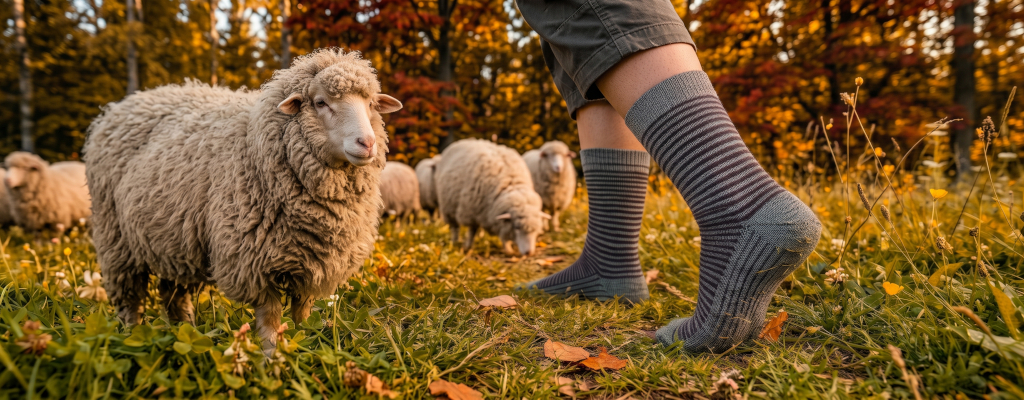
Coarse, traditional sheep wool can indeed prickle and irritate the skin. But ultra-fine Merino wool is an entirely different material class. Engineered by nature and refined through modern spinning, Merino is one of the most sophisticated performance fibers in textile science—naturally soft, thermo-regulating, and dynamically responsive to moisture.
When knit into high-performance hosiery, Merino wool does not cause irritation; it actively helps create a balanced, low-friction microclimate that protects active, sensitive feet on the trail, at work, or throughout daily life.
The Micron Metric: Why Traditional Wool Prickles (and Merino Flexes)
The difference between a sock that feels like sandpaper and one that feels like cashmere comes down to a single physical measurement: fiber diameter, measured in microns (μm, one-millionth of a meter).
The Mechanics of the “Prickle Point”
Human skin is lined with sensitive tactile nerve receptors. Biophysical research shows that when an individual textile fiber presses against the epidermis with a force exceeding 75 milligrams, it stimulates mechanical pain and itch receptors, triggering irritation and redness.
Whether a fiber exceeds that 75-milligram threshold depends directly on its thickness:
- Traditional Coarse Wool (28 to 35+ microns): Coarse fibers have high rigidity. Because they are thick, they resist bending. When the cut ends of traditional wool fibers push against your skin, they act like microscopic rods, exerting concentrated point pressure that activates the itch reflex.
- Fine-Micron Merino Wool (typically 18 to 21 microns): In beam physics, the force required to bend a fiber decreases exponentially with its diameter. Because fine Merino fibers are exceptionally slender, their bending resistance drops drastically. Upon meeting the skin, the fibers buckle smoothly at a fraction of the force needed to activate nerve endings.
Instead of jabbing into the skin barrier, ultra-fine Merino fibers flex and drape effortlessly, delivering a smooth, itch-free experience even for wearers with heightened skin sensitivity.
The Microclimate Engine: Natural Temperature Regulation & Vapor Buffering
Inside a closed walking shoe or hiking boot, the foot lives in an unforgiving microclimate characterized by heat buildup, friction, and humidity. While conventional athletic socks manage liquid sweat only after it pools, Merino wool operates on a fundamentally deeper physical level: it regulates humidity before sweat even condenses into a liquid.
1. Vapor Absorption vs. Surface Wicking
Most standard synthetic fibers (such as standard polyester or basic nylon) are hydrophobic; they do not absorb moisture into their internal structure. Instead, they wait for liquid perspiration to pool on the skin before pulling it across the fabric surface via capillary channels.
Merino wool features a complex bi-component architecture:
- A Hydrophobic Epicuticle: The waxy outer sheath of the fiber repels liquid water, shedding exterior droplets.
- A Hydrophilic Keratin Cortex: The inner core of the fiber readily attracts and absorbs water vapor directly from the boundary layer of air surrounding your skin.
Because of this unique interior structure, Merino wool can absorb up to 30% of its dry weight in moisture vapor before the fabric feels damp or clammy to the touch. By pulling humidity away while it is still an invisible gas, Merino prevents liquid sweat from pooling between your toes and along the footbed.
2. Shielding Vulnerable Skin from Maceration
For individuals with sensitive or compromised feet, moisture control is not merely a comfort preference—it is essential for skin integrity.
When feet sit in damp synthetic or wet cotton socks, the stratum corneum (the skin’s outer barrier) absorbs water and undergoes maceration. Macerated skin turns pale, softens, and loses structural tensile strength. In this weakened state, the horizontal shear forces generated by walking can tear delicate skin layers, leading to painful hot spots, blisters, and tissue breakdown.
By continuously buffering ambient moisture vapor, Merino wool socks help keep the skin dry, firm, and resilient against everyday friction.
3. Four-Season Microclimate Stability
Merino wool is not just a winter insulator; it is a true temperature regulating fiber that functions across all four seasons:
- In Cool Conditions (Heat of Sorption): When water vapor binds to the internal protein structure of wool fibers, a natural physical reaction called the heat of sorption releases a mild, steady thermal buffer, keeping feet comfortable in crisp weather.
- In Warm Conditions (Evaporative Cooling): As ambient temperatures rise or exertion increases, the stored moisture within the fibers evaporates outward into the shoe’s atmosphere, drawing excess heat energy away from the foot like an evaporative cooling system.
Two Engineering Philosophies: Vapor Buffering vs. Capillary Transport
At Creative Care, our technical knitting approach is built on matching the right yarn physics to the specific physiological demands of your footwear environment. While Merino wool is nature’s master of internal vapor buffering, engineered synthetics like CoolMAX® solve moisture management through high-speed capillary transport.
- Keratin Core Absorption: Pulls ambient water vapor directly into the fiber core before sweat condenses.
- 30% Vapor Capacity: Buffers up to one-third of its dry weight in humidity without feeling wet or clammy.
- Microclimate Stability: Provides natural thermal buffering (heat of sorption in cold, evaporative cooling in heat).
- Capillary Surface Channels: Multi-lobed filaments channel liquid sweat outward away from the skin.
- Rapid Surface Evaporation: Spreads moisture widely across the exterior fabric face for quick drying.
- High-Ventilation Performance: Delivers lightweight, ultra-breathable cooling for peak heat and heavy exertion.
Instead of absorbing moisture into its core, CoolMAX® relies on specially extruded, multi-lobed filaments with microscopic longitudinal grooves running along the fiber shaft. These channels act as micro-conduits that use capillary action to pull liquid perspiration away from the skin surface and spread it across the outer face of the fabric for rapid evaporation.
Prefer an Animal-Free or Ultra-Cool Synthetic?
If you require high-velocity cooling for warm climates, or wear rigid orthopedic braces that generate concentrated liquid perspiration, CoolMAX® delivers rapid mechanical wicking. Explore this channeled fiber technology in our Coolsense™ Socks, Healthy Soles™ Socks, and CoolMAX® AFO Liner Socks.
Fiber Comparison: How Textiles Behave Inside Your Footwear
| Textile Fiber | Fiber Diameter | Moisture Management Mechanism | Behavior When Wet | Skin Feel & Friction Risk |
|---|---|---|---|---|
| Coarse Traditional Wool | 28–36+ μm (Rigid) | High internal absorption | Retains moisture; slow drying | Prickles skin; high mechanical itch reflex. |
| Standard Cotton | 12–20 μm (Soft) | Sponge-like liquid absorption | Collapses into a heavy, soggy pad | High maceration hazard; clings and causes shear friction. |
| CoolMAX® Technical Synthetic | Engineered Multi-Lobed | Longitudinal capillary channels | Dries rapidly; does not hold moisture in core | Ultra-smooth slip plane; engineered for high perspiration. |
| Fine Merino Wool | 18–21 μm (Ultra-fine) | Internal vapor absorption (up to 30%) | Maintains loft and resilience without feeling damp | Bends smoothly on contact; helps stabilize skin microclimate. |
Precision Engineering: Creative Care Merino Hiking Socks
A high-performance natural fiber requires an equally sophisticated knitting architecture to deliver true protection. Leveraging over three decades of domestic manufacturing heritage, Creative Care engineered our Merino Hiking Socks to combine fine-micron wool science with anatomical support.
Proudly knit in our American facilities from fine imported yarns, these socks provide a balanced interface between sensitive feet and rugged footwear:
- Continuous Terry-Cushion Sole: Dense, shock-absorbing loop pile lines the entire footbed from heel to toe. This specialized padding diffuses vertical impact on hard trails and asphalt, buffering sensitive metatarsal heads and heel pads against direct ground stress.
- Targeted Elastic Arch Support: A contoured midfoot band gently hugs the plantar arch. This holds the sock securely in place inside boots or walking shoes, preventing the fabric from twisting, sliding, or bunching—a primary cause of friction hot spots.
- Low-Profile, Smooth Toe Seams: Conventional hiking socks feature thick, overlocked seams across the toes that rub against sensitive joint knuckles. Our precision low-profile toe closures sit flat against the skin, minimizing shear points and pressure lines.
- Comfort-Fit Stay-Up Cuff: Rather than using harsh, tight elastic bands that bite into the calf and leave deep indentations, our cuff is engineered to stay securely upright without pinching or restricting lower-leg circulation.
- Trail-Tested Aesthetic Accents: Built on a clean base with refined Striped or Diamond geometric accents (available in Black, Blue, and Burgundy), offering trail-tested durability with a modern look.
Caring for Technical Merino Knits
Because Merino wool fibers feature delicate natural crimps and protein scales, caring for them properly preserves their loft and thermodynamic properties for years:
- Skip the Softeners and Dryer Sheets: As detailed in our comprehensive guide, The Laundry Trap: Why Fabric Softener Destroys High-Performance Yarns, liquid fabric softeners deposit a hydrophobic silicone wax over textile filaments. This waxy coating seals the scales of natural wool, blunting its ability to absorb moisture vapor and regulate temperature.
- Wash Gently: Turn socks inside out to preserve the inner terry cushion. Machine wash in cool or warm water with a mild, clean-rinsing laundry detergent.
- Dry with Low Heat: Tumble dry on a low-heat setting or line dry to protect the elastane recovery yarns that keep your arch support snug and responsive.
Experience Natural Performance
You don’t have to trade comfort for outdoor durability, and having sensitive skin does not mean avoiding wool. By utilizing fine-micron fibers and precision technical knitting, Creative Care Merino Hiking Socks deliver the natural moisture-buffering and thermo-regulating benefits of Merino wool—keeping your feet cushioned, comfortable, and protected on every step of your journey.