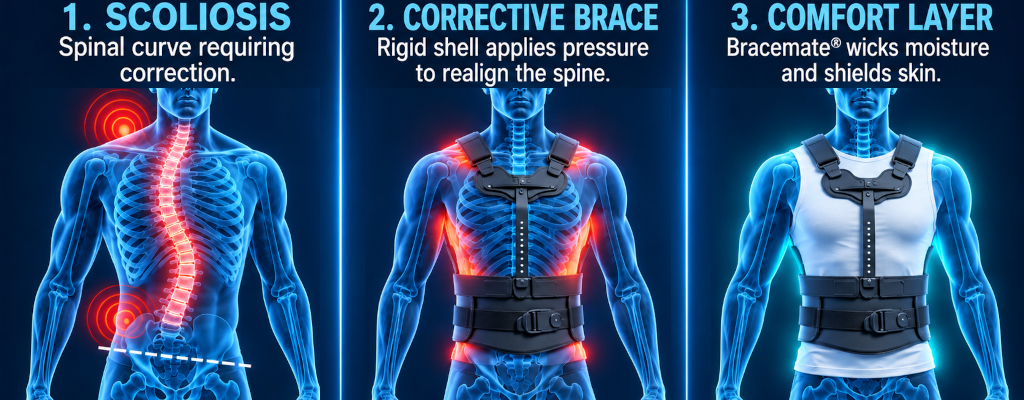
1. The Core Problem: Heat, Friction, and Pressure Points
Skin breakdown beneath a spinal orthosis is the direct physiological result of three distinct redundant stresses acting on the skin simultaneously:
- Thermal Trapping & Heavy Perspiration: Copolymer plastics and rigid polyethylene shells are non-porous thermal insulators. As the core body temperature naturally rises during daily movement or sleep, heat becomes trapped against the torso, triggering profuse sweating.
- Epidermal Maceration: Because sweat cannot evaporate through an airtight plastic jacket, moisture pools directly against the body. Prolonged moisture saturation causes epidermal maceration—the softening and swelling of the skin’s outer barrier (stratum corneum). Macerated tissue loses its structural strength and natural defense against abrasion.
- Dynamic Shear Friction: Every breath, step, and seated torso shift causes the firm edges of the plastic brace to slide across softened skin. Weakened tissue tears easily under this lateral friction, creating raw, burning chafe zones.
- Concentrated Pressure Points: Corrective orthotic pads must exert targeted force against spinal curves to do their job. When soft, perspiration-soaked tissue is pressed tightly between a rigid shell pad and an abrasive fabric fold, deep pressure ridges and subcutaneous bruising can follow quickly.
2. Why Standard Cotton T-Shirts Fail Under Rigid Braces
When first fitted with a back brace, many families reach for everyday 100% cotton crewneck tees or casual undershirts. Standard cotton undershirts can often promote brace-related skin complications:
- The Cotton Sponge Trap: Cotton is a hydrophilic (water-absorbing) plant fiber. It holds up to 27 times its weight in water, absorbing sweat like a sponge without the physical ability to transport or evaporate it away through the plastic shell. The wearer ends up trapped in a damp, cold, abrasive compress against their torso all day.
- Deep Pressure Ridges: Cotton fibers possess virtually zero elastic rebound memory. As the wearer bends or slouches, loose cotton gathers into thick, rope-like wrinkles. Under the tension of tightened brace straps, these bunched folds turn into rigid cords that can aggravate sensitive rib and hip skin.
- Raised Seam Trimlines: Off-the-shelf t-shirts rely on bulky overlock side seams and thick collar bindings. Compressed by rigid orthotics, these raised ridges create painful linear indentations and localized skin tears.
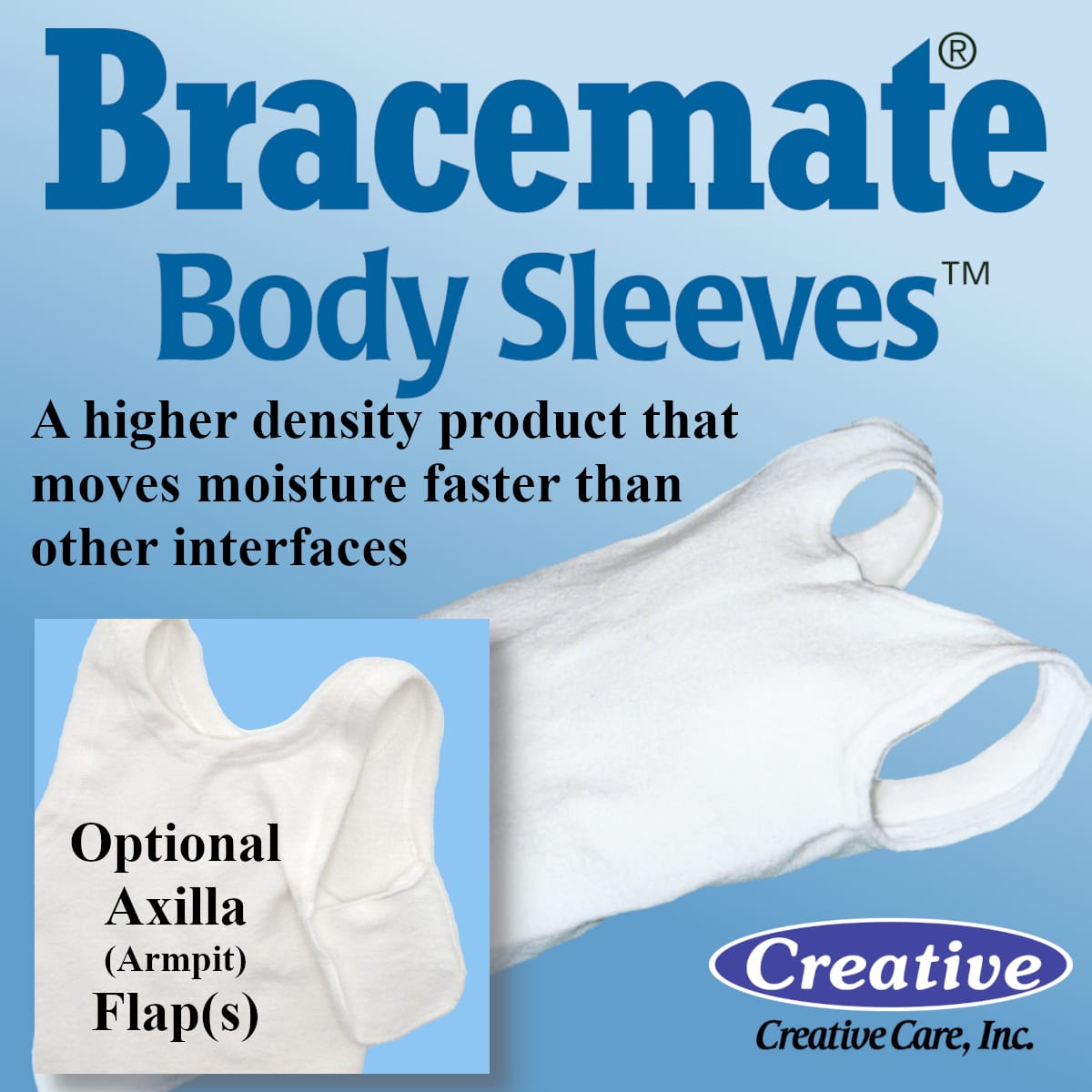
Bracemate® Body Sleeves™
Engineered specifically for rigid scoliosis body jackets (TLSO, Boston, Charleston). Features rapid CoolMax® moisture transport, 360-degree wrinkle-free stretch, and a seamless-feeling body interface helping to eliminate chafing.
3. The 4 Essential Features of an Orthotic Base Layer
To ensure daily comfort and keep spinal treatment on track, an orthotic shirt must function as a specialized interface rather than basic clothing:
- CoolMax® Channel Knit: High-performance, multi-channel polyester fibers create an active capillary network that moves sweat away from the epidermis to the outer surface, keeping the torso drier, cooler, and structurally resilient under sealed plastic.
- Multi-Directional Core Stretch: Continuous circular knitting utilizing core spun yarns conform to the body’s natural curves across the ribs, waist, and hips without sagging or bunching, minimizing the folds that cause pressure sores.
- Underarm Axilla Protection: High-profile TLSO and Boston jackets frequently rub against the sensitive axilla (armpit) fold. Integrated ambidextrous axilla flaps provide dedicated cushioning over the lateral edge of the brace shell without requiring separate left- or right-handed garments.
- Turned, Elastic-Free Comfort Welts: Rather than utilizing narrow elastic bands that bite into the skin or roll down under downward brace tension, a turned, non-binding top edge stays positioned comfortably without pinching or restricting circulation.
4. Interactive Fitting & Style Guide
Finding the correct configuration and size greatly enhances seamless, wrinkle-free fit beneath the brace:
Style Selection: Standard Straps vs. Axilla Flaps
- Standard Straps: Designed for standard mid-torso TLSOs and lower-profile orthoses where the top rim terminates safely below the axilla (armpit) crease.
- Axilla Flaps (Single or Dual): Designed for high-profile thoracic orthotics or scoliosis braces engineered with an elevated lateral shell or axillary extension. Because the single-flap model is completely ambidextrous, it can be rotated to cushion either the left or right underarm.
Understanding Technical Knit Sizing: The “Flat vs. Stretched” Reality
Bracemate® Body Sleeves™ are engineered on specialized knitting machinery to function like a wrinkle-free second skin. The CoolMax® corespun yarn aids in creating a drier environment and more intimate fit to the wearer than standard cotton tees.
⚠️ Sizing Notice: Why Your Sleeve Looks Small Out of the Package
When you unbox a Bracemate® sleeve, its relaxed, unstretched dimensions appear compact (a Medium measures 8″ wide flat). This is intentional engineering: high-recovery elastane requires a snug relaxed state so that once stretched over the torso, it maintains uniform contact without gathering or sagging. If an orthotic base layer fits loosely straight out of the package, brace tension would immediately bunch the excess fabric into potentially painful, blister-causing pressure ridges. Trust the stretch circumference – it is engineered to expand smoothly.
Torso Circumference & Dimension Matrix
Select your size by measuring your torso circumference at the widest point across your chest or ribs:
| Size | Relaxed Flat Width | Relaxed Flat Length | Torso Stretch Circumference Range | Best For |
|---|---|---|---|---|
| Small | 6″ | 14″ | 16″ – 34″ | Pediatric to Petite Adolescent |
| Medium | 8″ | 16″ | 22″ – 40″ | Slender to Average Teen / Adult |
| Large | 11″ | 20″ | 26″ – 48″ | Mature Teen to Broad Adult Torso |
| X-Large | 15″ | 24″ | 30″ – 56″ | Full Torso / High-Profile Orthosis |
General Fitting Tip: Measure around the widest circumference of the chest or ribs. The circular knit expands across a wide stretch spectrum, so selecting the size corresponding to your active circumference provides a smooth, second-skin fit without rolling at the edges.
5. Technical Fabric Care & Longevity
High-performance orthotic base layers require proper laundering to preserve their capillary wicking channels:
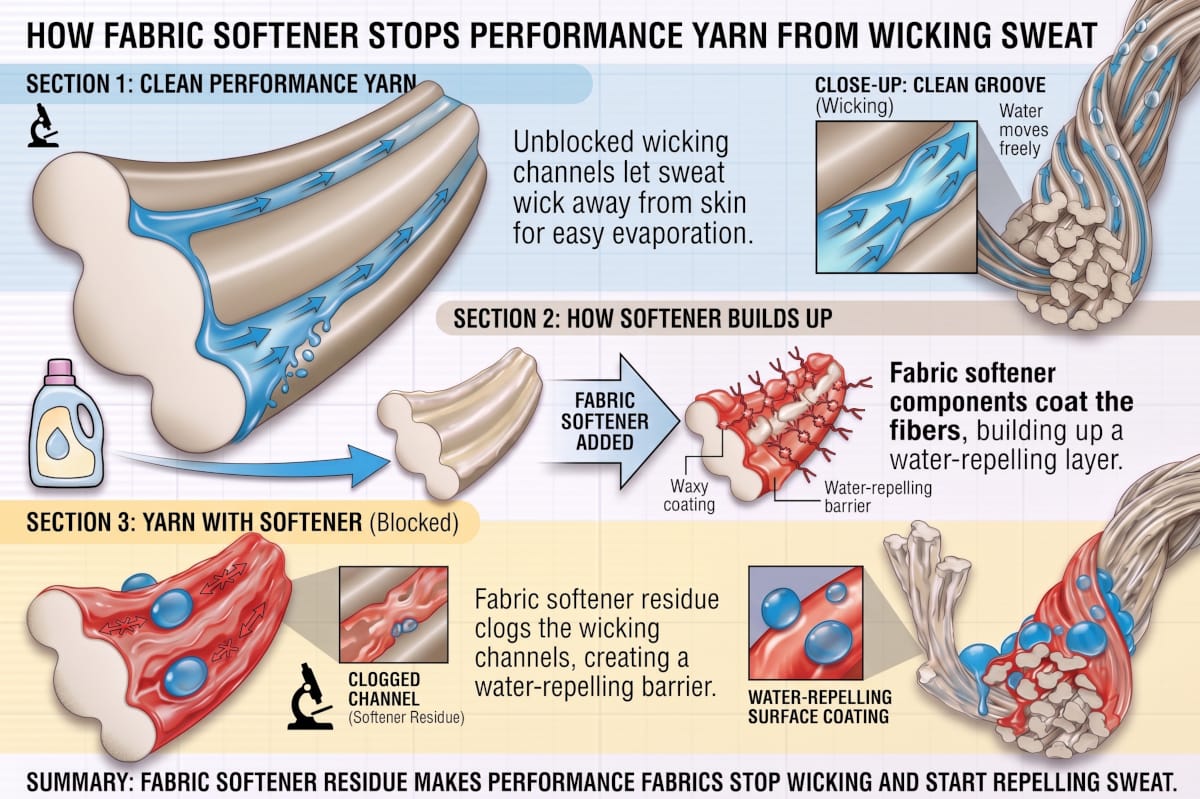
- Never Use Fabric Softeners or Dryer Sheets: Liquid softeners and dryer sheets deposit a waxy silicone emulsion over technical fibers. This film clogs microscopic wicking channels, destroying moisture transport and causing technical knits to trap sweat against the skin.
- Washing & Drying: Machine wash in warm water using a mild, clean-rinsing liquid detergent. Tumble dry on low heat or hang dry to preserve the elastane core integrity.
Bracemate® Body Sleeves™
Engineered specifically for rigid scoliosis body jackets (TLSO, Boston, Charleston). Features rapid CoolMax® moisture transport, 360-degree wrinkle-free stretch, and a seamless-feeling body interface helping to eliminate chafing.